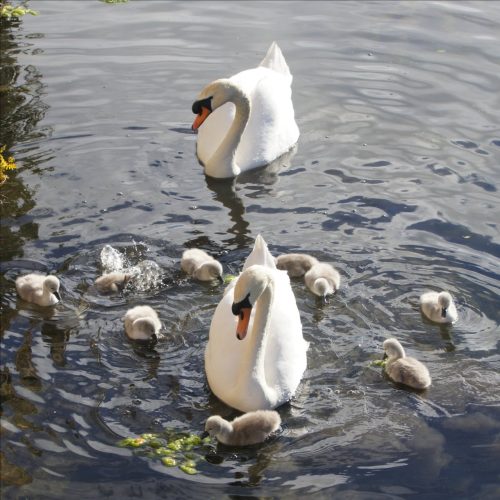
Tracking Swan Movements
The Lothians and Fife Swan and Goose Study Group has undertaken a study of the Mute Swan population of the Lothians since 1977 and carried out an extensive and intensive colour ringing programme from 1982, including regular ringing of the Craiglockhart broods. However, the last occasion was in 2019 as the Covid pandemic led to its suspension in 2020.
Ringing Study
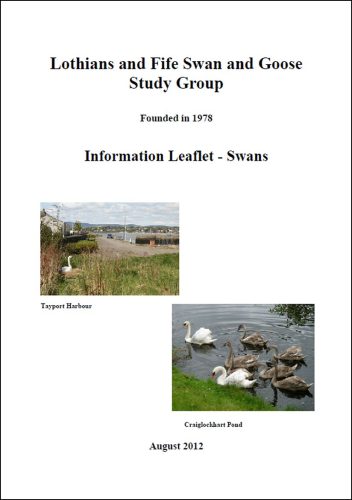
They have amassed a large amount of data on the movements and survival of swans in the area, which they are currently analysing. Their ringing study has come to an end (other than the occasional re-ringing) and there are now few ringed birds in the population as a whole. The Group’s 2012 leaflet, although rather dated now, gives some interesting background to the study.
It is unlikely that they will ring the Craiglockhart cygnets again, as this would no longer form part of their wider study. In addition, the colour rings they use now are not as robust as previously, often cracking, chipping, becoming worn or coming off completely. This then requires recapture of the birds to add a new ring, and monitoring which can no longer be undertaken once the cygnets have left Craiglockhart pond. To track swan movements you need to use colour rings as the metal rings are not easily read in the field. They also have concerns about spreading avian influenza when catching wildfowl.
There is not currently anyone else who could ring the swans of keep track of future broods. Also, the Group already has considerable information on previous cygnets, so there is no need to undertake any further ringing for the study at present.
Where do cygnets go when they leave?
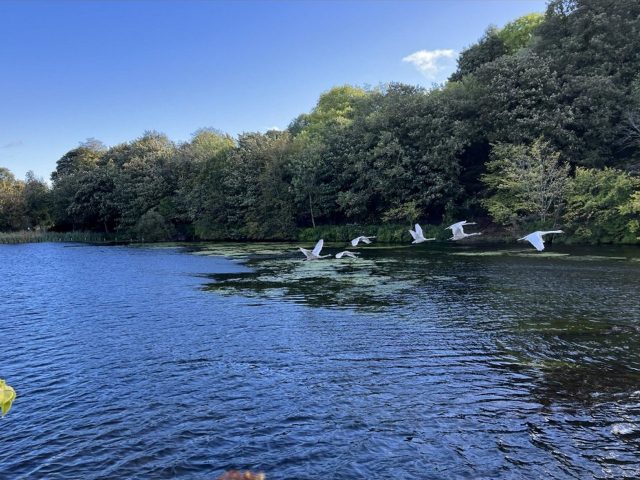
Many of the cygnets join existing flocks in locations such as Musselburgh, St Margaret’s Loch in Holyrood Park (although this is not used so much now), Cramond, Linlithgow Loch etc. Some fly outwith the Lothians, moving to locations in Glasgow, the Borders and Fife. Throughout the study there have been no instances of Craiglockhart cygnets returning to the pond to breed, as resident pairs have often held the territory for considerable periods.
An interesting movement is for male cygnet TIC which was ringed at Craiglockhart Pond on 1st September 2018. His parents were TIH and NUU, and he remained on the pond until March 2019 before leaving and not being seen again until 29th May 2021 at Letham Pools in Fife, and then at The Wilderness, Ladybank on 12th April 2022. He was not seen again until 13th March 2025, when he was spotted at Birnie & Gaddon Lochs LNR, Collessie, where he was re-ringed UBV on 23rd October 2025 (the TICring having gone missing). He paired up with an unringed female at Gaddon Loch, fledging two young in 2026.
Allan & Lyndesay Brown
Lothians and Fife Swan and Goose Study Group
A Craiglockhart Story
FECH’s resident swan-watcher adds that the male swan ringed TIH was known to us as Siegfried, who formed a pair with Brighid, the female ringed NUU, between 2016 and 2023.
Siegfried hatched at Stenton Pond, near Glenrothes in Fife, in 2012. He was ringed NZZ as a cygnet, but that ring came off and he was re-ringed TIH in 2018. He left Stenton Pond for Loch Gelly in Fife, and then travelled to St Margaret’s Loch, Musselburgh, Loch Leven, Leith Docks, and Linlithgow Loch. Brighid was one of a brood of six that hatched at Craiglockhart Pond in 2012, and was ringed NUU as a cygnet. She moved to St Margaret’s Loch, Leith Docks, Musselburgh, Inverleith Pond, and Beal Sands in Northumberland, then returned to Scotland and spent some time at Duddingston Loch before arriving at Craiglockhart Pond with Siegfried to make one of the longest-running breeding pairs the pond has ever hosted. Together they successfully raised 41 cygnets over 7 years.