Meadow Management on Easter Craiglockhart Hill
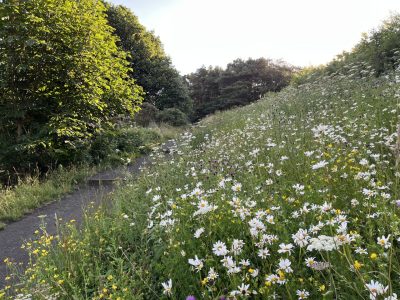
We are lucky enough to have several areas of meadow on Easter Craiglockhart Hill. FECH and the City of Edinburgh Council work together to manage each slightly differently depending on their size and location.
Where are the meadows?
The largest meadow is half way up the hill and covers about an acre of land above the zigzag steps. It is in three parts called the Lower, the Upper and the Pipeline meadows.
Smaller areas of meadow have been seeded and planted around the hill too. A 100sqm area at the entrance on Craiglockhart Terrace was planted in 2022, and a smaller one next to the old croquet lawn (now a car park) on Craighouse (near where the music school building used to be) was planted in 2024. A very small patch beside the pond near the gym also began being reestablished as a meadow in 2026, after years of mowing.
What sort of meadows are they?
The large Lower meadow area was created in 2018 and is abundant in perennial plants which bloom and seed at different times between April and September with dozens of species providing cover, pollen and nectar for many creatures on the LNR. Amongst these perennials are self-seeding plants which drop their seed during the year which then germinate in the spring of the next year.
The smaller meadows were established by FECH with seed and wildflower turf and are home to many species of perennial and self-seeding wildflowers.
How are the meadows managed?
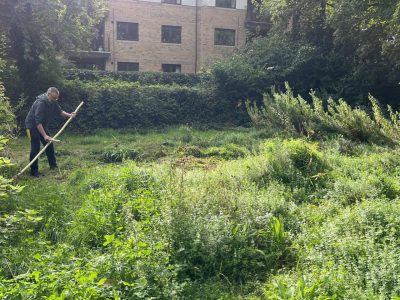
FECH have an ongoing project to establish a sustainable population of different species within all of our meadows. We aim to keep the meadows healthy for our pollinators and provide habitat for amphibians, rodents and birds. We want to increase the biodiversity so that nutrition will be available across the whole breeding cycle for bees, butterflies and other insects too. FECH plant native species under the guidance of Edinburgh Council’s Natural Heritage officer. We also spread seed sourced from within the meadows, such as yellow rattle, so that we get a good distribution of this important meadow plant.
FECH manage some of the more aggressive species of plants such as dock and rosebay willowherb in order to prevent these species dominating. This is a very labour intensive process but does allow less vigorous species to flourish in their place.
The larger areas of meadow are mowed by the council in the autumn. and the cuttings are left for several days to shed their seeds before being raked off by volunteers from Lothian Conservation Volunteers (LCV) and FECH. The raked material is then left to decompose naturally to the side of the meadow. This allows the seed to drop from the cuttings and ensures that the soil is not enriched by the composting plant material. In this way we ensure that the wildflowers can compete with the grasses in slightly denuded soil. If the cuttings were not removed, then the vigorous grasses would dominate the area and the wildflowers would not thrive.
Our smaller meadows are scythed by volunteers or cut by Edinburgh Leisure, and the cuttings are again left for several days before being removed.
When do we mow the meadows?
The Council usually schedule the mowing towards the end of October; it depends on the weather and availability of staff. FECH try to get the other meadows scythed in late September but again it depends on the goodwill of our volunteers.
Why do we need to mow at all?
The best way to manage our meadows would be to introduce grazing animals to the land over the autumn and winter, but obviously this is impractical on an urban LNR.
FECH would prefer to scythe all of the meadows on the LNR but it is a long job and we just do not have the people to do it. Scythed cuttings are far easier to rake off too, so it would be a huge effort-saver, but sadly there are not enough volunteers to scythe the full area.
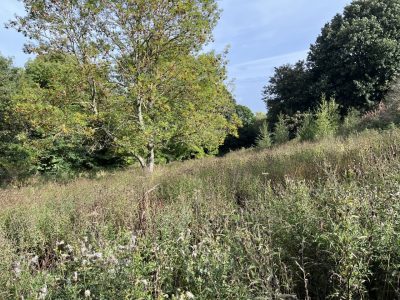
The health of the meadow does depend on being cut back hard in the autumn. Otherwise, this area of the hill would be dominated by grasses, which would not provide the same range of diversity and foodstuff for the insects on the hill which support other creatures.
Why don’t we mow in the spring as well?
The simple answer is that we don’t have the resources to do this. The Council have committed to mow in the autumn and FECH do not have the tools or people to be able to do it by ourselves.
What resources guide our decision-making on meadow management?
FECH are guided by the landowner (Edinburgh Council) as to what to plant on the LNR and on the meadows.
FECH also takes guidance from NatureScot, Plantlife and the Woodland Trust. A simple google search will reveal much more information about meadow management but please remember that we are limited in the amount of work we can do by the numbers and skills of our volunteers.